
Matilda is a multi-task framework for learning from single-cell multimodal omics data. Matilda leverages the information from the multi-modality of such data and trains a neural network model to simultaneously learn multiple tasks including data simulation, dimension reduction, visualization, classification, and feature selection.
Matilda is part of Multi-Task Omics, alongside scMultiBench and M3.
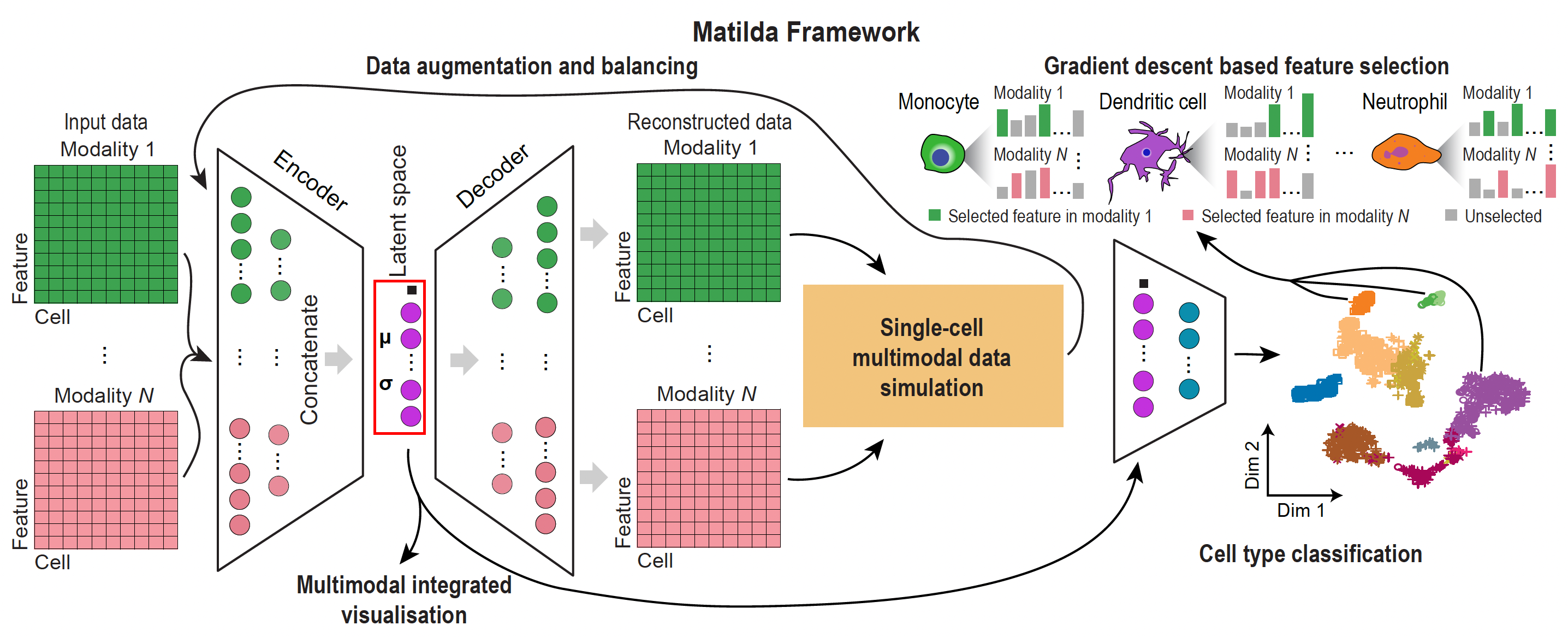
For more details, please check out our publication.
This repository packages Matilda as a Python package (pip install matilda-sc, import matilda) and an R package, wrapping the unchanged published engine, with documentation and runnable Colab tutorials.
- Documentation: https://pyanglab.github.io/Matilda/
- Python tutorial (Colab):
- R tutorial (Colab):
- R package: https://github.com/PYangLab/Matilda/tree/main/matilda-r (SingleCellExperiment-based, Bioconductor-style)

Python (import name matilda; PyPI distribution matilda-sc):
pip install matilda-scR (Python is provisioned automatically by basilisk, so you never install or manage it):
remotes::install_github("PYangLab/Matilda", subdir = "matilda-r")Matilda ships as a Python package (import matilda) and an R package (matilda, operating on a
SingleCellExperiment). Both call the same engine, so on the same hardware they give the same
result. Pick the interface that matches your workflow; see the documentation
for both APIs and full tutorials.
Work with in-memory AnnData (or arrays, or file paths) and get results back as objects. After
train, there is one verb per task: classify / reduce / markers / simulate.
import matilda

# rna/adt/atac: AnnData | ndarray | scipy.sparse | path | None
# labels: a vector, an `.obs` column name, or a .csv path (string or numeric labels)
fit = matilda.train(rna, adt=adt, atac=atac, labels="cell_type")

res = matilda.classify({"rna": q_rna, "adt": q_adt, "atac": q_atac},
                       model=fit, query_labels=q_labels)
res.predictions        # DataFrame: cell_id, real, predicted, probability
res.celltype_accuracy  # DataFrame: celltype, accuracy, n

lat = matilda.reduce({"rna": rna, "adt": adt, "atac": atac}, model=fit)                        # lat.latent
mk  = matilda.markers({"rna": rna, "adt": adt, "atac": atac}, model=fit, labels="cell_type")   # mk.markers
sim = matilda.simulate({"rna": rna, "adt": adt, "atac": atac}, model=fit, celltype="B.Naive", n=200, labels="cell_type")  # sim.simulated
The modality combination is inferred automatically (RNA only, RNA+ADT for CITE-seq, RNA+ATAC for
SHARE-seq, all three for TEA-seq). classify reconciles features automatically: if the query is
missing some of the model's features it takes the per-modality reference intersection (real values,
no zero-padding), retrains, and classifies; res.retrained / res.common_features report what
happened. See the Quickstart and
API reference for the full surface.
If you use Matilda, please cite the Matilda paper
Liu C, Huang H, Yang P. Multi-task learning from multimodal single-cell omics with Matilda. Nucleic Acids Research, 51(8), e45 (2023). https://doi.org/10.1093/nar/gkad157
(see the Citation page).